Thursday, May 29, 2014

Ferroni Matters

How far would you go to make sure learning matters for your students? Would you make a promposal to model Brittany Mason? Create a Vine to send to soul singer Maxwell? Mass tweet Chipotle? Share with your students that you glued your ears to your head when you were twelve and never went to prom?


How about turn down a six-figure salary as Susan Lucci’s love interest to teach high school social studies?


If you’re Nick Ferroni, that was your Friday of last week.


I met Nick through Twitter. Both of us are New Jersey teachers, went to Rutgers, and are around the same age. But, that’s about where it ends on its surface. Nick was a three-star high school athlete, a scholarship division I football player, made some money underwear modeling, and had walk on roles on a soap opera. I wear underwear, played sports, and hated soap operas.Nick, me.jpg-large
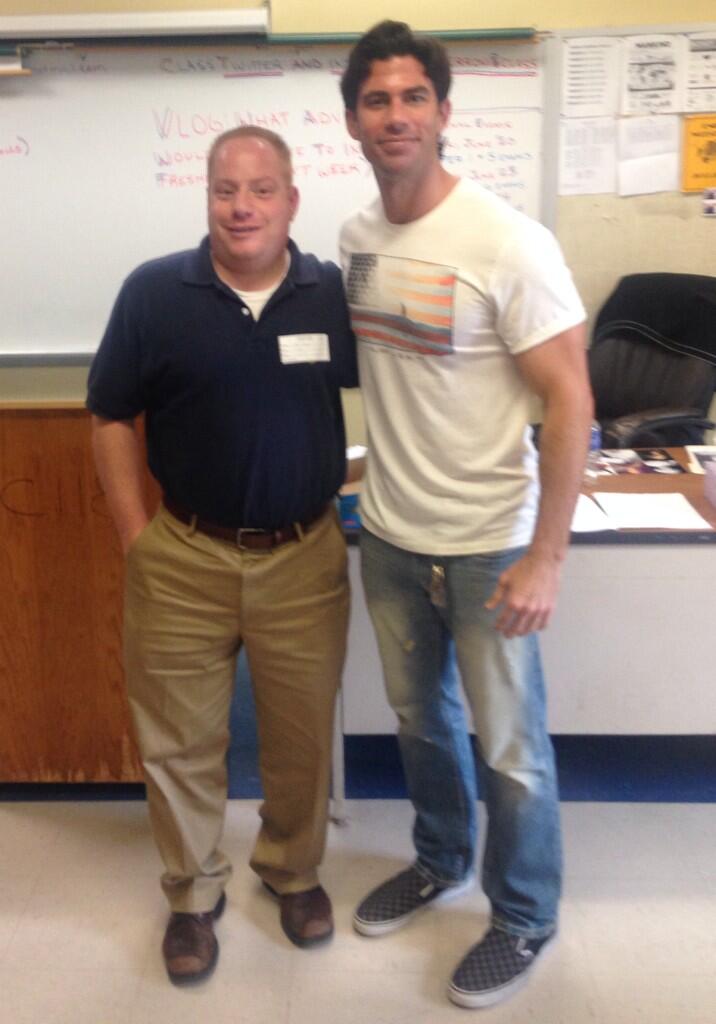

If you look at our picture together, there’s me on the left, and the man who Men’s Health called “One of the 25 fittest men in America” on the right. Nick’s biggest takeaway from this picture? His forehead looks shiny. My biggest takeaway: my body looks like Mr. Potato Head and it’s time for me to get a personal trainer.


Where Nick and I are similar is where we matter: we’ll both go to any lengths to make sure students learn, and how we define learning is much deeper than what’s in any textbook, teacher’s guide, or curriculum. We’re looking at students long-term: what impact will they have on society, and what impact will society have on them? What can we do to aid students so they have a positive experience in life, bouyed with a skill set transferrable to any situation. Can we teach them to solve problems, collaborate, advocate, compromise, and think creatively? Can we get them to push their boundaries from what they think they can do to what we think they can do?
Nick will buy gym memberships and train students who need a positive emotional release. He has a stack of protein bars in his desk in case his students get hungry. He leverages his experiences in theatre and the arts to invite in Maxwell, Brittany Mason, Brian Leonard, and more, to talk about their life experiences. Then, Nick weaves these experiences to draw parallels to the subject he teaches. Because, when he shuts the door, Nick is the curriculum. And, he takes that job seriously.


Which is why, when I have an opportunity to hang with a high energy, humble, creative rockstar educator, I’m going to do it. Even if it means waking up earlier than usual, driving an hour, and going to another school when my district is closed. This is probably how Nick’s students feel when they come to school: that there’s something worth coming inside for. And, that is half the battle.


Nick allowed me to live tweet the charades his students did to prepare for the US History 1 exam they had coming up. The energy, enthusiasm, and engagement I saw from the students and their teacher made me want to join in. Here are a few of them, as well as the class Twitter feed:
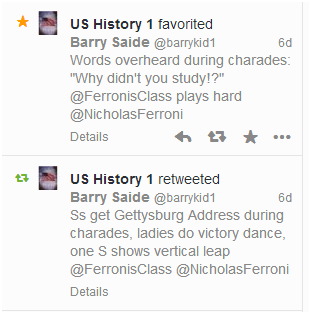
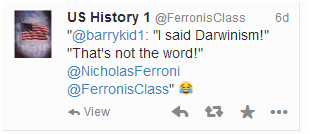
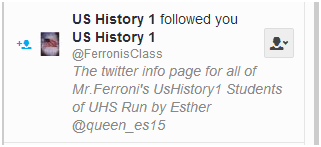
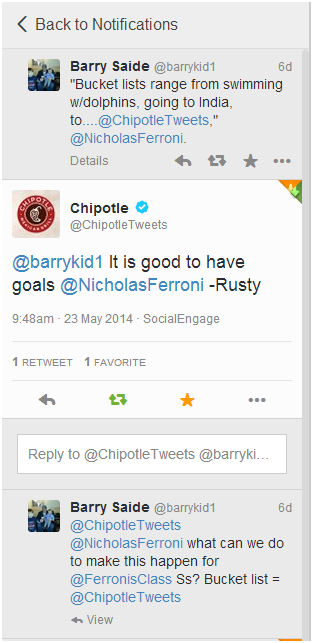
When I left later that day, I learned two things about Nick and his students: they have a real desire to eat Chipotle before their lives are over, and I want to spend more time with them. I hope both happen soon so we can cross them off our bucket lists. Maybe we can all go to Chipotle together? (FYI, still waiting for a tweet-back from Rusty).

Sunday, May 18, 2014

What Are Your Non-Negotiables?

The Common Core State Standards tell us what students should know and be able to do academically at the end of a school calendar year. They are, in essence, non-negotiables. But, what about you? What are your non-negotiables?

What should your students know and be able to do when they leave your classroom, your school, or your district? What’s most important that you can pass on to them?

Early in my teaching career, one of my non-negotiables was being a content and control specialist. I knew my material and loved to share it at the front of the room. I orated and did my best Dead Poets Society and Stand and Deliver impersonations. The content was dry, so I needed to make it fun by being ‘the fun teacher.’ I thought that was how teaching was done: by replicating what I’d been through in public education, what I learned in college courses, and what I’d seen in movies. But, I wasn’t teaching: I was wasting our time. Students were bored because I was teaching them that learning is boring. No wonder they passed notes, talked while I was talking, and made poor decisions. I put them in that position by keeping them isolated in their seats all day. I would have done the same thing if I were a student in my own class.

As I’ve grown as an educator, I’ve changed this non-negotiable. I’ve moved from a teacher-centered environment to a student-centered one. I’ve learned that I can’t control the learning outcome. Students control that. I can’t make students learn. Students control that, too. What I can do is create an environment that is conducive to student learning occurring: short mini-lessons and active student engagement, while embedding cooperative learning and character education in each lesson. I can make the learning environment fun, and through that, I can teach students that learning is fun. Because, when learning is fun, students will stay engaged in the process, even when it gets hard.

The Common Core State Standards are hard. There is a lot to cover, and the depth is tremendous. I can see why teachers get overwhelmed and scared. This is why I believe it is so important to know our non-negotiables, and fall back on our personal mission statements: what do I want my students to know and be able to do at the end of a school calendar year? What are my non-negotiables as an educator and a person. What is my role?

Even with the advent of the Common Core State Standards, my role as an educator hasn’t changed: if anything it’s become more important to stick to my moral compass. I need to work with students to create an environment that is safe, so they are comfortable learning and taking risks. I want to help build creative, outside-the-box thinkers of strong character, ones who use rejection or failure as opportunities to grow. My objective at the end of the year is to help activate the problem solving and skill set necessary within my students so they will be successful when they’re adults. Because, they will learn from this failure and rejection, and work harder by growing from it. But most of all, when students leave at the end of a school calendar year, I want them to know I didn’t teach them anything: we learned it together.

Now, I don’t want people to think I’m down on the Common Core State Standards. I believe in them. I think there’s a lot of good stuff in there. I work with different education constituencies to assist educators in understanding the instructional shifts brought about by the Common Core. However, at our core, it is important that we always remember why we are educators, and what the most important thing we can do as educators -- and that’s too build the next generation of society with the skill set necessary for success in college, career, and life.

Thursday, May 15, 2014

Impressions Leave a Mark

Zig Ziglar once said, “It’s not where you start that counts, it’s where you finish that matters.” As my students and I begin the last stretch of our almost ten month journey together, I don’t want them to lose sight of their own personal growth as people and students. If school ended today, I’d want them to be proud of their development as citizens and lifelong learners. They are on their way to making their mark on society. But, our school year isn’t over today. We have five weeks to continue to grow, develop, reflect, hold ourselves and each other accountable, and be better than we were the day before.

Which is why, one day recently, as my students gave their worst impression of ball toss during Morning Meeting, it was time to talk about our lasting impressions, and the legacy they leave.

Our class has Morning Meeting at the beginning of each day. We begin with a whole class greeting, making sure we’ve all said hello to one another. Our current favorite greeting is Ball Toss greeting. In this greeting, a student verbally says good morning to another, tosses a tennis ball to them, and is greeted back by the student who caught the ball. This student then greets another student and tosses them the ball. Over the course of the greeting, each student has been greeted, has greeted another, caught the ball, and tossed it. Everyone is involved. As we’ve become more proficient doing this over time, we’ve added more balls to the greeting. Each ball continues the same pattern as the first ball, being thrown and caught by the same ordered people pattern until the final person has all the tennis balls. As an additional challenge, the last person who caught the ball during forward ball toss reverses the direction. We then do ball toss backwards and non-verbally, so the ball travels back to the person who began the greeting, but no one can speak as we do it.

However, what happens when everyone is involved in Ball Toss but not engaged? The students were not holding themselves accountable to the guidelines they set for themselves. The start didn’t look any better than the end: students and their peers dropped balls, made errant, no look throws, giggled, and wayward tennis balls lightly hit peers in the face and stomach. I could have chalked up our approach and execution to the Monday morning blues. Or, that standardized testing had finished the prior Thursday. But the combination of our foibles, and our reaction to them, made me feel that this was something different. We needed to talk about it, not excuse it away.

I asked the students to stop the greeting and sit down. I asked them to reflect on why they thought we stopped. They identified our errors, citing busy weekends, the end of standardized testing, being a Monday, and a plethora of other reasons why our minds weren’t in the greeting. Would they have used these reasons if we were taking a quiz today? A standardized test? If their parents were here? Would these reasons have been acceptable then? When prompted, they all shook their heads no, and explained why it wouldn’t have been acceptable.

“Why is it okay for you to do it now and why will you accept less than your best?” I asked. “How do you want me to remember you? How you want to remember each other, and our year together?”

They were staring at me. They were engaged. They wanted to explore these questions. Now, how was I going to drive this moment home? How would I help them see that this wasn’t about ball toss anymore. It was about how we carry ourselves, how we hold ourselves (and each other) accountable. And, how we bring our best effort every day and expect that of others. Because, we’re worthy, they’re worthy, and neither of us should accept anything less. Ever.

When I want to reflect, I write about it (see this post). It provides me with perspective. I asked the students to do the same: write a letter to themselves explaining what they did and why they did it. On the back of the paper, they were asked to write down their personal goals for their final 28 days as fifth graders. “People are going to remember you for the first impression and last impression you make,” I reminded them. “How do you want to be remembered here in your final year in elementary school? What should your legacy be?”

After five minutes of writing, I cooperatively grouped students. They were asked to speak to their group members about their writing. I would circulate, but I was a silent observer. This wasn’t about me. This was about students sharing their thoughts, listening to their peers share theirs, and discuss how they would learn and grow from this experience.

When students returned to their seats, they were invited to share a synopsis of what they wrote. They didn’t have to, but many did: “I want to be remembered as a good student and a good person.” “I want my classmates to know I gave my best effort.” “I am going to enjoy these last 28 days the way I enjoyed every other day by doing my best.”

I thanked the student sharers for their honesty. I then asked them to keep the paper in their classwork folder. This paper wasn’t for me to collect and use to remind them of the deal they made with themselves. This was about each student holding what they wrote close to them, and referring back to it until they didn’t need to anymore. Until they began to do these things naturally, consistently, leaving a positive impression wherever they go. Because, that’s what people will remember. And people should remember the good that’s in all of us.

Most importantly, that’s what I want my students to carry with them as they go through life: a positive lasting impression that leaves a never-ending mark, and a willingness to reflect when they haven’t. Both will be more powerful lessons learned than anything else I will ever teach them. I hope that my impressions will leave a mark, and we will consistently learn from each experience begun, whether we finish each one or not.

Saturday, April 26, 2014

Doggy Bag

Ever get your hand caught in the cookie jar? What about the poopy bag?

I did. And, I didn’t handle it well.

The other day I was walking my dog. She went, and I picked it up. Problem was there was a hole in the bag. I didn’t notice where the hole was until it was too late. The bag began to leak. I begin to walk quickly in the direction of my house. I begin to get coated. Life gets worse.

My dog, all 65 pounds of her stops, dead in her tracks. She needs to go, again. By this time my hands and arms are beginning to resemble the poop bag. She repeats the process. For those keeping score at home, Bella is two for two.

I don’t even have a bag for the first one, much less the second one, which is on my neighbor’s lawn. I decide retreating is the better part of valor. I wait until she’s done, get my hustle on, and figure I’ll clean up, get another bag, and get her other parting gift. Only my neighbor doesn’t know my plan, he just sees me scurrying away.

“Sir, Sir,” I hear from behind me. I turn. I am literally coated from hands to elbows in Labradoodle poop.

“Your dog went on my lawn,” says an older man, pointing to the spot where Bella did her business. He’s well-dressed, and quite proper looking. Think Fred Gwynne (Herman Munster) sponsored by Polo.

“I see it,” I snap. “I have no room in the bag. I’m coming back.”

“Okay,” he says, staring at me. And, that is where it should’ve ended. But, because of my emotional - mental state right then, it didn’t.

“Is there anything else,” I say, turning fully toward him. We’re about 100 feet away. I lift up my hands and elbows so he can see them. “Or are we good?”

My question isn’t really a question. It’s not even a statement. I’ve just overreacted and unloaded on a neighbor. Who. Did. Nothing. Wrong.

But, my mind isn’t there. See, my Dad is in the hospital. He’s had four bypass surgeries in the last 19 years. He’s not getting enough blood to his heart. The arteries are fully working, it’s just not enough. There’s a lot of plaque around the heart. He’s got two options, stent, or some other crazy procedure I can’t understand. But the man who asked me to be a good neighbor doesn’t know that. He just knows what he sees.

He looks at me, stunned. He wasn’t expecting that response. Because, there was no reason for me to go there. None. And, he’s unsure how we got there. I showed no outward signs that something was wrong (minus the poop coating).

So, he does the right thing. He models graciousness and courtesy: “No problem,” he says, smiling. “Have a good day.”

Me, now I’m doubly angry, because I overreacted and am ashamed of my reaction, and, I still have arms dipped in poop chocolate. I need to make this right, I think. But first, I need to wash my hands.

How often do we form judgements about our students, their families, our teaching peers, or our administration, based on just the information we see? We see a child who calls out, acts out, doesn’t hand in homework, has trouble staying seated, fidgets, argues in a group, and we make a final decision without all the pieces in place. Have we checked to see if: they had breakfast, slept, were told by their parents that they’re moving or divorcing (or both), feel like they have no friends, don’t understand the content, have prior bad experiences in education, or come from a family who mistrusts school? Any, a combination, or all of them, can play a role in the output of a child. But, if we look at an incomplete picture and make a complete judgement, how does that help the child? Doesn’t it just give them the wrong message about us and about education in general, because we’ve made a generalization that many not apply?

We tell ourselves as educators that we need to drop our baggage at the door prior to entering the building. The students need it, and we deserve to give them our best. Remember “exhibit A” (me): we don’t always model appropriate behavior. The motivations behind our poor actions may have no correlation whatsoever to what actually occurred. Who makes a scene covered in poop? This guy, who’s dad is in the hospital, and has bigger issues on his mind than his neighbor’s lawn.

So, the next time we’re ready to make a snap decision as educators, realize that even though we’re older, mature, trained, and passionate about what we do, we’re still human. As adults, we do things we later regret. We handle things poorly. And, children, their families, our peers make these mistakes too. At some point, with enough reflection, adults can figure out why they reacted as they did, and then choose how to move forward. Children don’t have the coping skills or metacognitive skills to understand why they make the decisions they do. Developmentally, their frontal lobe isn’t fully developed until their mid-20’s.

Heck, I could tell you some of the decisions I made in my mid-20’s.

But, I’d prefer not to.

Now, my Dad will be okay. He’s been transferred to another hospital. The surgery will be performed by a doctor who’s last name is biblical. According to those in the field, this man can part platelets. My Dad will have his stent put in, he’ll go home in a few days, and we’ll all move forward.

But for me, I have to move backwards, down the street to my neighbor. I have some apologizing to do.

The Obsessive Educator

A hot buzzword in education is the term ‘connected educator.’ For the past year, I’ve gone to unconferences, EdCamps, and had countless Twitter interactions. We always talk about what a ‘connected educator’ is.

Well, what about an ‘obsessive educator’?

It’s important to recognize this type of educator, too, as they are a strand of the ‘connected educator’. An obsessive educator is eternally hungry for teaching and learning knowledge. So hungry, that they’re never full. They’ll attend Saturday free conferences the weekend before Thanksgiving because they want to learn something, be inspired, meet others like them, and go home with their passion ablaze. Snow on a Saturday in Philadelphia? No problem for the obsessive educator. The pros way outweigh the cons. The obsessive educator burns the candle at both ends, only because there isn’t a third end.

The default setting for an obsessive educator is to communicate. Once an obsessive educator learns something new, they need to try it out immediately. And, then share out: not to brag or show off, but to deconstruct what just happened -- so more learning can occur. They want to break down why something worked, why something didn’t, or what they can do better.

They also want to help others get better. Making an investment in someone else by sharing new knowledge makes the obsessive educator happy. They know at some unknown future point, their investment will pay a dividend because a student will learn. And, that’s in their job description..

The obsessive educator is a teacher first, next, and always. And with teaching, there will be times when their peers don’t comprehend the material. They won’t see its relevance. Why do that? Who has time? Everything is already good the way it is, the obsessive educator hears. However, the obsessive educator sees a different picture than others hear. They don’t see the forest or the trees. Their vision is longer term, and it’s beautiful: a place where we are all connected and an obsession with learning becomes the norm.

But, they understand that their obsession is not the norm now. They understand that not everyone gets stoked when Tom Whitby and Todd Whitaker follow them on the same day. They understand that by taking pictures of the educational badges from the conferences they’ve attended that people they love, respect, and even marry may call them “Nerd Camp.” Because, the obsessive educator believes they get it -- the rest of the world will just catch up soon.

Wednesday, April 2, 2014

Shiny, Happy People

It was the middle of a long week and there was no end in sight. My priority list seemed neverending. I grumbled as I walked into school. I was tired, and I didn’t care who knew it. My vibe was not a good one. And, it was the wrong one.

The first day I welcomed in a new group of students and told their parents not to worry, that their children would be fine under my care, my life stopped being about serving myself and began about serving others. This job stopped being about me a long time ago, and I’d forgotten about that.

I felt like road kill. And, that’s okay. It’s human to be tired. It’s not okay in our field to let it affect us, because that impacts not just us, but the students we serve, the families who entrust us to keep their children in the forefront of each decision we make, and our teammates who feed off our energy.

That’s why outside of this day, whenever a student or a co-worker had asked me how I was doing, I’ve always told them some combination of: “I’m awesome,” “I’m great,” or, “Never had a bad day.” Because everyone benefits from hearing that. Maybe it lifts us up, maybe it serves as a model for keeping a positive attitude.

Or, maybe my students, parents, or peers walk away and think I’m nuts. But, if they’re tired, not feeling well, or life has dealt them a bad hand that day, I’ve at least given them something else to think about: that guy must be nuts. How is he always in a good mood?

In reality, I’m not always in a good mood. I have arthritis, which can make some mornings tougher than others to loosen up and get moving. I have two boys, a three-year-old, and a 19 month-old. Neither has mastered sleeping overnight. However, I have the potential to wake up and put others in a good mood each day, and that’s a powerful thing. How many people can change someone’s day with a handshake, a smile, a nod of the head, raised eyebrows, or a silly face. Who was I to take away someone’s potential positive mindset because I had a long to do list!? That’s a misuse of power, and, that makes me sad, which is worse than being tired.

As I walked into my classroom, I reflected on how I felt, acknowledged it, and put it aside. Because, my day was now about investing in others: making each person I came in contact with feel significant, that they belonged to something, and the environment they came to each day was fun. This was no place for a sleepy party pooper.

I checked my coffee and diet soda to make sure I was armed for the day, turned on the tunes, and sat at my desk. It was time to review my plans, look at my morning message, and create another positive experience for those I would come in contact with that day.

We may not always feel like shiny, happy people. But, we do need to put that out there for our students, their families, and our peers. They deserve nothing less than our best. We can always nap later.

Sunday, March 16, 2014

Creating a Room Full of Leaders

There was a quote spoken twice over a week-long span that resonated with me. The first time I listened to it I tweeted it out. It was a great thought in a presentation full of them. The second time the quote was said, I understood it. There was a difference.

The quote was, “Leadership is what happens after you leave the room.” Irvin Scott, Deputy Director of Education at the Gates Foundation said it during his evening keynote welcoming us at ECET2 (Elevating and Celebrating Effective Teachers and Teaching). A week later, after hosting 50 New Jersey educators at a professional development event on digital leading and learning, Matt Hall, Supervisor of Science and Technology in Bernards Township said the same thing.

So why did it take me two times to truly figure out what they both meant?

It’s a complex thought: the idea that what you do and how you do it will show itself (positively or not) when you’re not there. The rationale is that if we’ve created the right environment, empowered the people in it to be involved in the environment’s creation, agreed upon very specific norms about what’s expected and why when we are there, the people who inhabit the room will continue to follow it when we’re not. 

Why? And, how does this apply to teacher leaders, site-based leaders, and the students they serve?

Whether you’re a teacher or an administrator in a building, chances are, if your environment is running smoothly it’s because you’ve created an expectation about ‘how things are done here’. There is buy-in because those involved were given a voice and a choice in how ‘things here’ operate. Then, once rules and guidelines were established, the teacher or administrator made sure to reinforce expectations when needed, but in a positive way so teachers or students retained their dignity. This created an atmosphere of trust between those in the room and the person in position of power. It’s clear to all who witness a private exchange take place that even if they can’t hear what was said, the way the teacher or administrator handled it was respectful. When a teacher asks a student to step outside for a moment and then never refers to it again, or gently whispers something in a student’s ear and continues their room rounds, the student knows, ‘if I mess up, I’ll be held accountable for it, but I won’t be embarrassed publicly. It’ll be a private thing.’

The same holds true for when a conversation like this is held between an administrator and teacher. When an administrator visits a teacher in their room and has the hard conversation in private this may make the teacher uncomfortable, but it also creates mutual respect. At some point, just as other students know a conversation took place but don’t know the details, teachers know when an administrator spoke to a peer. Someone always sees or hears something. And, when (or if) it’s our turn having that conversation, we’re going to feel comforted knowing it will be handled the same way we know it was handled before. That shows caring.

As a teacher, the note I love to read from a guest teacher when I am absent is: ‘your students were wonderful. They were just a pleasure to teach.’ This lets me know that even when I’m not there, my leadership still is. It’s there because I have empowered my students to be leaders. They police themselves, support each other, have the hard conversation, and hold all accountable (even themselves). Because, they want to. My hope is that when they become a leader in their own field, they will continue to model these qualities and the cycle will continue. 

The next time someone says, “Leadership is what happens after you leave the room,” remind yourself of the time spent in the room to create the environment that functions well when you’re not there. Because, the students aren’t doing it by themselves. They’re modeling leadership in the room you taught them in.